
Your cart
There are no more items in your cart
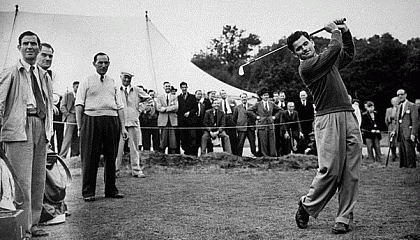
From the coastal links of Scotland to the mountains of Kobe, hickory golf connects today’s players with an earlier,more instinctive form of the game.
The Origins
The exact origins of golf remain debated. Stick-and-ball games were played throughout medieval Europe, but the game that developed into modern golf is most closely connected with Scotland. The earliest known written reference to golf in Scotland dates to 6 March 1457. King James II ordered that golf and football be stopped because they distracted men from compulsory archery practice. The ban was evidently unsuccessful—it was repeated in 1471 and again in 1491.
Over the following centuries, golf became established on Scotland’s coastal links. These landscapes of sandy soil, natural grasses, dunes and strong sea winds were perfectly suited to the game. At St Andrews, the public’s right to play golf on the links was formally recognised in a charter of 1552. It was here, among Scotland’s seaside towns, that golf’s traditions began to take shape.
The rise of hickory
Early golfclubs were made by hand using a variety of woods. During the 19th century, however, hickory became the preferred material for shafts.
Native principally to North America, hickory combined strength with natural flexibility. A well-selected shaft could withstand the repeated force of a golf swing while still providing the player with feel through impact. Scottish clubmakers imported the timber and transformedit into shafts for individually crafted clubs. Unlike today’s precisely manufactured equipment, hickory clubs were never completely uniform. Each shaft had its own weight, flex and character. Golfers often assembled their bags gradually, choosing clubs according to feel rather than purchasing a perfectly matched set. This individuality became central to the hickory game. A player had to understand each club and work with its particular qualities. Rhythm, balance and timing were generally more valuable than force.
By the late 19th and early 20th centuries, golf was expanding rapidly. Railways made coastal courses more accessible, while Scottish professionals, architects and clubmakers carried their knowledge abroad. New courses and golfing societies appeared across Europe, North America, Asia and the wider world. This period became known as the golden age of hickory golf.
The great hickory players
Some of golf’s most influential champions built theircareers with hickory-shafted clubs.
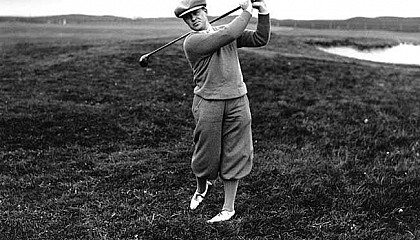
Harry Vardon, James Braid and J. H. Taylor dominated British golf around the turn of the 20th century. Walter Hagen became one of America’s first internationally recognised professional golfers, while Bobby Jones emerged as perhaps the most celebrated amateur in the history of the game. The hickory era reached a remarkable conclusion in 1930, when Jones completed his historic Grand Slam. In a single season, he won The Amateur Championship, The Open Championship, the U.S. Open and the U.S. Amateur. At Royal Liverpool, Jones won The Open with rounds of 70, 72, 74 and 75. He achieved this while continuing touse hickory shafts, even as a growing number of competitors were beginning to adopt steel. His achievement demonstrated the extraordinary standard golfers had reached with equipment that relied so greatly on feel, craftsmanship and the player’s ability to adapt.
The arrival of steel
Experiments with steel shafts had taken place for several years, but they initially faced resistance. Some golfers disliked their feel, while others believed they provided an artificial advantage.
The USGA permitted steel shafts in 1924, and The R&A followed in 1929. During the early 1930s, steel rapidly gained acceptance.
For manufacturers, steel offered greater consistency. Shafts could be produced with similar weights and flexes, allowing companies to create coordinated sets of clubs. Steel was also less vulnerable to warping and breakage than natural wood. By approximately 1935, it had largely replaced hickory as the standard shaft material. Hickory golf’s original competitive era had come to an end, but millions of wooden-shafted clubs remained in private homes, professional shops and clubhouses around the world.
Some became collectors’ pieces. Others would eventually return to the course.
Golf arrives in Japan during the hickory era
Japan has a particularly meaningful connection with hickory golf because the country’s golfing history began while hickory clubs were still the standard equipment of the game.
In 1901, British merchant Arthur Hesketh Groom created a small four-hole course near his summer residence on Mount Rokko, overlooking Kobe. Two years later, on 27 February 1903, Kobe Golf Club was formally established. Its first nine-hole course opened that May, before expanding to 18 holes in 1904. Kobe Golf Club became the first golf club in Japan. Every golfer who played there during its earliest years would have experienced the game in its hickory form. This makes hickory more than a foreign historical curiosity in Japan. It is part of the country’s own golfing beginnings. From Kobe, the game gradually spread. Courses including Naruo Golf Club, founded in 1920, helped establish the traditions of Japanese golf during the final decades of the hickory age. Early Japanese golfers learned the game when wooden shafts, handcrafted clubs and relatively small playing sets were still normal. For modern Japanese hickory players, returning to this equipment is therefore a way of reconnecting with the opening chapter of golf in Japan.
Japan’s modern hickory revival
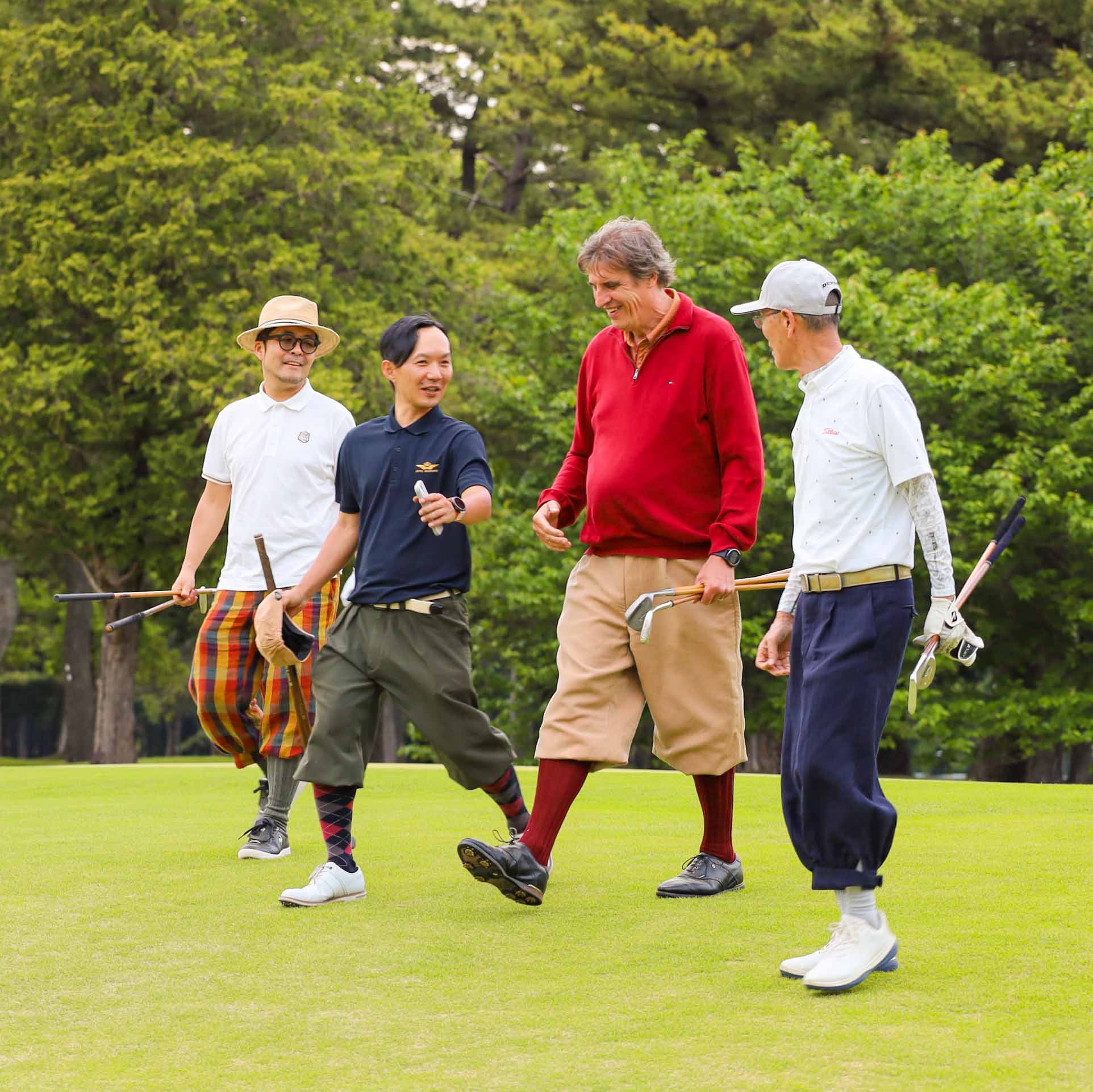
A new Japanese hickory community began to take shape in the 2010s.
In 2013, the first Happy Hickory Golfers event was held in Karuizawa. It brought together players interested not only in historic equipment, but also in the sociable and less score-conscious spirit associated with hickory golf. The movement continued to grow. The inaugural Japan Hickory Open was held at Kobe Golf Club in 2017—a fitting return to the place where golf in Japan had begun more than a century earlier. The Japan Hickory Golf Society subsequently joined the World Hickory Open’s international partner programme in 2019. Japanese players also began achieving notable results overseas. Team Japan won the World Hickory Open Best Ball competition in 2018 and has since recorded multiple international team victories. In 2023, Japan won the Archie Baird International Team Event, while Rie “Alice” Mitsuhashi won the women’s division. Japan secured the international team title again in 2025, when Takuya Yoshikawa was also named the men’s amateur champion.
Japan’s domestic hickory calendar has expanded as well. Tournaments and regular meetings now bring together players from different regions of Japan, while international events have welcomed golfers from across the Asia-Pacific region.
A significant milestone came in 2023, when Taiheiyo Club hosted Japan’s first PGA-sanctioned hickory tournament. The participation of Japanese professionals demonstrated that hickory golf could be treated as more than a historical exhibition: it remained a genuine test of golfing skill.
Why hickory golf survives
The return of hickory golf is not an attempt to reject modern equipment. It offers a different way to experience the same game.
Hickory shafts encourage a smooth tempo and make it difficult to overpower the ball. Distances are shorter, results are less predictable and players must create shots instead of relying entirely on specialised technology. The imperfections are part of the attraction. A well-played hickory shot produces a distinctive feeling precisely because the club does not make it easy. There is also a strong social element. Hickory events frequently bring together players of different ages, nationalities and abilities. Traditional clothing may add to the atmosphere, but the deeper tradition lies in the attitude: enjoying the course, appreciating a good shot and not allowing a poor one to spoil the day.
From Scotland’s early links to Mount Rokko, Karuizawa and Tokyo, hickory golf has travelled far beyond the period in which it was born. Its survival is not simply about preserving old clubs. It preserves a form of golf built upon creativity, companionship and character. More than a century after golf first arrived in Japan, the hickory shaft continues to connect Japanese players with both the birthplace of the game and the beginning of their own golfing history.
Sources and further reading
- National Library of Scotland — Early Moments in Scottish Golf
The 1457 Act of Parliament and the earliest known Scottish reference to golf. - Historic Environment Scotland — St Andrews Links
The historical development of links golf and the 1552 St Andrews charter. - The R&A World Golf Museum
An overview of more than 400 years of golf history and equipment. - The Open — Bobby Jones
Jones’s championship record and scores from the 1930 Open. - Kobe Golf Club — History
The establishment of Japan’s first golf club by Arthur Hesketh Groom. - Japan Hickory Golfers Club
Information about Japan’s contemporary playing community and events. - World Hickory Open — Japan’s 2018 Best Ball Victory
The record of Team Japan’s international victory. - World Hickory Open — 2025 Championship
Results including Japan’s team title and Takuya Yoshikawa’s men’s amateur victory. - Society of Hickory Golfers — Asia-Pacific Championship in Japan
Coverage of Japan’s growing role in international hickory golf.
Publish date: 10/8/2026